|
Land
Tibet has abundant land resources. Of its total area of 1.2 million square km, 650,000 hectares are pastureland, accounting for 53.79 percent of the total, and 360,000 hectares are cultivated land, accounting for 0.3 percent. Most of the cultivated land is distributed in the southern Tibetan river valleys and basins, while the remaining small portions are scattered in the east and southeast of the region. A large proportion of land, or some 30.71 percent of the total, is yet to be utilized. As the largest grasslands, Tibet leads Inner Mongolia and Xinjiang in terms of the area of natural grasslands.
Plants
Tibet is richly endowed with plant resources, with more than 5,000 species of higher plants. Gyirong, Yadong and Zhentang in southwest Tibet and Medog, Zayu and Lhoyu in southeast Tibet are known as museums of rare plants. Even in north Tibet, with its extreme natural conditions, there are more than 100 species of plants.
Forests, concentrated in the Nyingchi area, still retain their primitive nature. Plant species are abundant here. Almost all kinds of plants and vegetations found in the Northern Hemisphere, from the tropical to cold areas, can be found here. Moreover, tracts of surviving ancient plant population are still preserved.
The forest reserves in Tibet stand at 2.08 billion cubic meters, and forest coverage rate reaches 9.84 percent. Common tree species include Himalayan pine, alpine larch, Pinus yunnanensis, Pinus armandis, Himalayan spruce, Himalayan fir, hard-stemmed long bract fir, hemlock, Monterey Larix potaniniis, Tibetan larch, Tibetan cypress and Chinese juniper. The coniferous forests composed of spruce, fir and hemlock have the widest distribution, mainly in the humid subalpine belts of the Himalayas, Nyainqentanglha and Hengduanshan mountain ranges. They account for 48 percent of the total forest area in Tibet, with their reserves making up 61 percent of the total. Pine forests cover about 926,000 hectares in Tibet. The Tibetan longleaf pine and lacebark pine are the species peculiar to the region, thus being put under the state-level protection.
One of the five largest pastoral areas in China, Tibet boasts 82.67 million hectares of grassland and 23 million heads of livestock, annually producing 9,000 tons of wool, 1,400 tons of cashmere, and 4 million pieces of cowhide and sheepskin. The Northern Tibetan Grassland covers an area of some 600,000 square km, or about half of Tibet's total area. It is called "Changtang" by local people. "Changtang" means "northern grassland" in Tibetan.
There are over 1,000 kinds of plants with medicinal properties. They include some 400 kinds medicinal herbs commonly used in the traditional Chinese medicine, and some 300 kinds used to make Tibetan medicine with special curative effect. Major ones include tuber of elevated gastrodiae, safflower, bulb of fritillary, pseudo-ginseng, rhubarb, root of hairy asiabell, large-leaved gentian, root of red-rooted salvia, glossy ganoderma and reticulate millettia. These medicinal herbs are so high in production that, after satisfying the needs of the Tibetan-inhabited areas, there is still a surplus to be exported to other parts of China. Some are even sold overseas.
In addition to the aforementioned wild plant resources, the forests hold many kinds of fungus. Of the 200-plus fungi, many are edible, including some kinds of mushrooms, Auricularia auricula-judae and tremella. Tibet also produces precious medicinal fungus including glossy ganoderma, Chinese caterpillar fungus, fuling (Poris cocos), and stone-like omphalia.
The major grain crops in Tibet include qingke barley and wheat. The main bean plants include broad bean and pea. Rapeseed is the major oil bearing crop. The subtropical areas in southeast Tibet produce such grain and cash crops as rice, corn, buckwheat, Chinese sorghum, peanut, and sesame seeds. In the past 10-odd years, the region has introduced green house technology, enabling a variety of vegetables to be grown on this highland. Such vegetables include turnip, cabbage, potato, carrot, bokchoi, celery, garlic, spinach, cauliflower, Chinese chives, kidney bean, asparagus lettuce, pumpkin and cucumber. Southeast Tibet also produces apple, pear, peach, banana, orange, grape and some other kinds of fruit.
Wild Animals
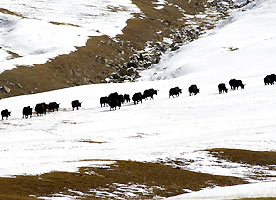
Tibet boasts 142 species of mammals, 488 species of birds, 56 species of reptiles, 45 species of amphibians and 68 species of fish. There are all together 799 species of wild vertebrates in the region. Among them 123 species are under key state protection, accounting for one-third of the national total under key protection. They include tiger, leopard, monkey, kiang, wild yak, red deer, white-lipped deer, antelope, lynx, musk deer, lesser panda, otter, Tibetan eared pheasant, cranes and python. Forty-five wild vertebrates including Yunnan rhesus monkey, Benglese tiger, snow leopard, kiang, wild yak, takin, white-lipped deer, red-spotted antelope, black-necked crane and red-chest tragopan are either on the verge of extinction or peculiar to Tibet. Himalayan Tar sheep, an animal under first-class protection, can occasionally be seen in places of Gyirong and Nyalam with an elevation of 3,000-4,000 meters at the foot of the Himalayan Mountains.
Tibet is also home to 2,307 species of terrestrial invertebrates (insects), which belong to 1,160 genuses, 173 families of 20 orders. The Chinese Zoreaptera and Metog Zoreaptera are under key state protection. Tibet is also rich in the varieties of beneficial insects. There are 103 species of bees, most of which are insect pollinators of flower-bearing plants. Nine species of bats and moth in Tibet grow in the brush marshland and alpine marshland some 3,600-4,500 meters above sea level.
Mineral Resources
More than 100 kinds of minerals have so far been discovered in Tibet, of which 36 have proven reserves, with those of 11 kinds ranking among the top five in China. They are chromium, industrial crystal, corundum, high-temperature geotherm, copper, volcanic ash, magnesite, boron, native sulphur, mica and arsenic. Other important minerals having good prospects for development include kaolin, gypsum, peat, crystal graphite, antimony, bolognian stone, gold, silver, molybdenum, pyrite, lead, zinc, cobalt, lithium and sylvine.
Of the minerals with proven reserves, chromium leads the country in its reserves. Chromium iron deposits cover a total area of 2,500 square km. Luobusha Mine in the Shannan Prefecture has become a development base of chromium iron in the region.
In 1999, a new mineral—natural lithium carbonate—was first discovered in Chabyer salt lake at the elevation of 4,400 meters. The lake is now not only the largest lithium mine in China but also one of the three largest salt lakes in the world. It makes Tibet the No.1 area in the world in terms of prospect lithium reserves.
Energy
Tibet is poor in coal, oil and natural gas, but rich in hydro-, geothermal, solar and wind energy resources. The first deep oil deposit has recently been discovered at the Changtang Basin in north Tibet, with bright prospect of oil reserves.
Hydro-energy:
Tibet is especially well endowed with hydroelectric power resources, having approximately 200 million kw of hydraulic energy resources, or about 30 percent of China’s total. The majority part of Tibet’s hydraulic energy resources is concentrated in southeast Tibet. The main stream of the Yarlung Zangbo River promises 80 million kw of hydraulic energy reserves, which can amount to 80 million kw when added with the reserves in its five major tributaries—the Dogxung Zangbo, Nyang Qu, Lhasa, Nyang and Parlung Zangbo rivers.
Geothermal energy:
Tibet is a region with the most dynamic geothermal activities, with more than 1,000 sites found to have prospective geothermal energy reserves. Of the 169 geothermal fields and hot spring areas already surveyed, 22 percent show a water temperature of 80 degrees Centigrade; about 26 percent have a water temperature of 60-80 degrees Centigrade; 35 percent, 40-60 degrees Centigrade; and 17 percent, lower than 40 degrees Centigrade. Tibet's geothermal heat discharge adds up to 550,000 kilocalories per second, equivalent to annual heat generation by 2.4 million tons of standard coal. The Yangbajain Geothermal Field in Damxung is currently China’s largest high-temperature steam geothermal field. The hot water temperature stands at 93-172 degrees Centigrade. The place now is a well-known scenic spot.
Solar energy:
Tibet leads the country in solar energy resources. In most parts of the region, the average annual sunshine stands between 3,100-3,400 hours, averaging nine hours a day.
Wind energy:
There are two wind belts in Tibet. Their annual wind energy reserves are estimated at 93 billion kwh, ranking the seventh in China. Except east Tibet, all other areas in the region have and can use their affluent wind energy resources. The Northern Tibet Plateau in particular enjoys over 4,000 hours of effective wind velocity annually.
Climate
As Tibet's terrain declines from an elevation of 5,000 meters in the northwest to several hundred meters in the southeast, the climate features frigid and dry air in the northwest and warm and humid in the southeast. The climatic types from southeast to northwest include tropical, subtropical, plateau temperate, plateau sub-frigid and plateau frigid zones. In southeast Tibet and the canyon area on the southern slope of the Himalayas, the temperature gradually drops with the rising terrain, and the climate takes a vertical change from tropical and sub-tropical to temperate, frigid temperate and frigid zones.
The atmospheric pressure in Tibet is low. Air is rare on the Tibetan Plateau with the oxygen content in a cubic meter of air being only 62-65.4 percent of that on the plain.
Tibet boasts more solar radiation than any other part of China, about 100 percent or one-third more than in plains at the same latitude. In addition, Tibet enjoys longer duration of sunshine, reaching 3,021 hours annually in Lhasa. However, it is 1,186.84 hours in Chengdu and 1,932.5 hours in Shanghai. The difference in temperature between day and night is enormous in Tibet; however, so far as the whole year is concerned, the seasonal difference is small. Both the annual average temperature and the highest temperature in Lhasa and Xigaze are 10-15 degrees lower than in Chongqing, Wuhan and Shanghai, which lie on a closer latitude. The seasonal difference in temperature in Lhasa, Qamdo and Xigaze is 18-20 degrees. In the Ngari area, 5,000 meters above sea level, the temperature in August reaches 10 degrees Centigrade or higher during the day, but falls to below zero at night.
Dominated alternatively by westerly wind in winter and southwesterly wind in summer, Tibet has a clear distinction between dry and wet days. Generally speaking, the months from October to April are a dry season while the months from May to September are a wet season, with precipitation during the period accounts for some 90 percent of the annual total. Rainfall is unevenly distributed in different places of Tibet, with a remarkable demarcation line between dry and rainy seasons. Annual precipitation amounts to 5,000 mm in the low-lying area in the southeastern part, dropping to 50 mm in the northwest.
|